
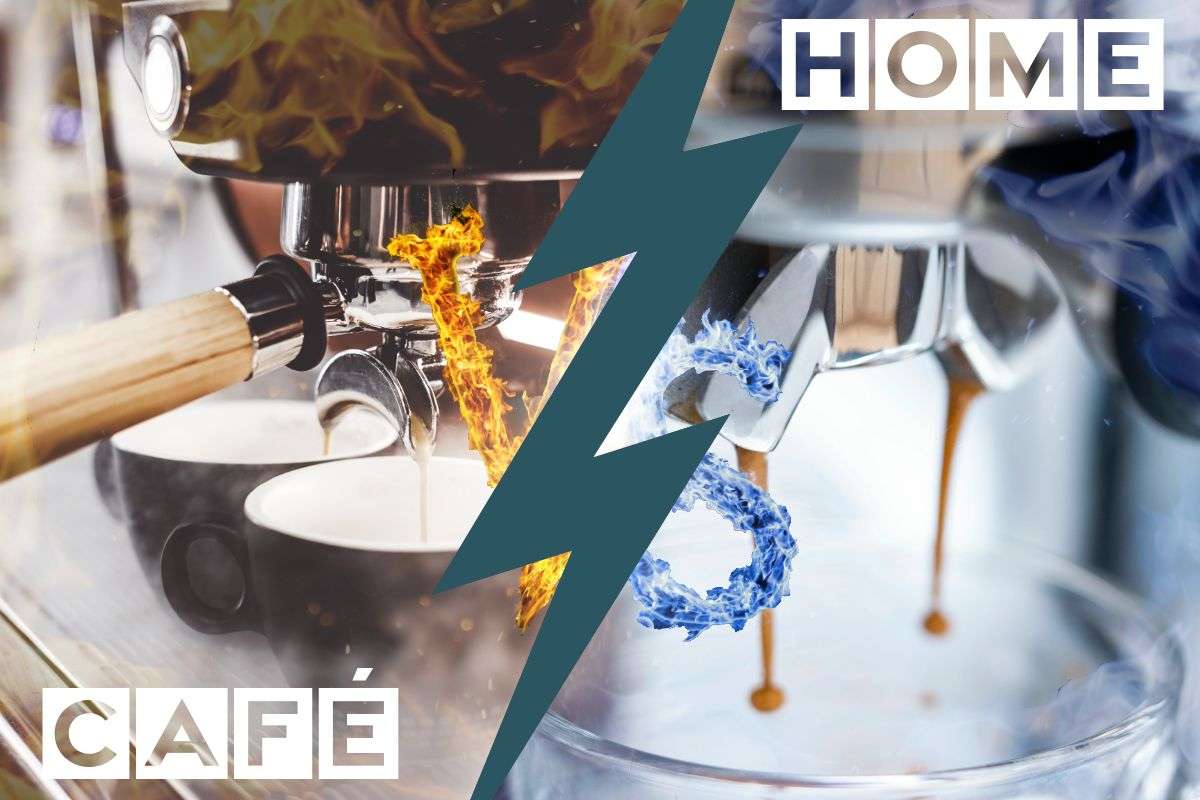
It’s a question that percolates in the minds of many coffee enthusiasts: can the espresso made in the comfort of one’s home with a personal machine truly rival that of a café, where commercial-grade equipment reigns supreme?
The initial assumption that many people have is straightforward: cafés, with their commercial-grade espresso machines worth tens of thousands of dollars, must inherently produce better espresso. At first glance, this makes sense. Commercial machines boast superior components, enhanced temperature stability from larger boilers, and are designed for a high-volume, consistent brewing workflow. These factors contribute to the belief in the unmatched quality of café-brewed espresso.
However, this assumption doesn’t hold up under scrutiny. The essence of a truly exceptional espresso lies not in the machine alone but in the hands of the person brewing it. The knowledge, skill, and understanding of the brewing process play crucial roles in determining the quality of the espresso. It’s important to recognize that espresso brewing involves a myriad of variables, and mastery over these is essential for achieving the perfect cup.
To understand how you might achieve or surpass café-quality espresso at home, it’s essential to revisit and comprehend the critical variables in the espresso brewing process.
Grind size
In the commercial realm, espresso grinders are designed for efficiency and consistency at a large scale, equipped with oversized burr sets that can quickly process a high volume of beans while maintaining a uniform grind. Such capability ensures that even during peak hours, a café can deliver consistent quality to its customers. However, the dynamics shift when we bring the focus into the home environment. Here, the luxury of time affords a more measured approach, emphasizing quality over quantity.
For the home barista, the objective shifts towards achieving the most consistent grind possible, a task less about speed and more about precision. The reason for this prioritization is clear: a uniform grind size ensures even water distribution during the espresso extraction process, which is essential for unlocking the full spectrum of flavors and aromas from the coffee beans. Uneven grinds, with their mix of coarse and fine particles, can lead to uneven extraction—over-extracting the finer particles while under-extracting the coarser ones, resulting in a shot that is both bitter and sour, missing the harmonious balance sought by aficionados.
Grind amount
The amount of coffee grounds used in the filter basket is pivotal for several reasons. Primarily, it determines the espresso’s strength, with more grounds resulting in a stronger, more intense flavor. Additionally, the grind amount affects the puck resistance—how easily water can flow through the coffee grounds. Optimal puck resistance ensures a balanced extraction, where water has just the right amount of contact time with the coffee to extract the flavors without over-extraction or under-extraction, both of which can lead to undesirable tastes.
Commercial settings often leverage grinders that dose by weight, ensuring a consistent amount of coffee grounds is used for each shot. This consistency is crucial for maintaining the quality of the espresso, especially in high-volume environments where consistency and efficiency are paramount.
For the home barista, achieving this consistency poses a unique set of challenges and opportunities. While some home grinders offer grind-by-weight capabilities, they are often at a higher price point and may present a greater margin of error compared to their commercial counterparts. However, an increasingly popular method among home enthusiasts is to weigh the coffee beans before grinding and then measure the grounds after grinding, using a single dose grinder. This approach allows for precise control over the grind amount, ensuring that each shot of espresso can be brewed with the same consistency in terms of strength and flavor.
This meticulous process of weighing before and after grinding offers several advantages. It not only allows for fine-tuning the espresso to personal taste preferences but also contributes to a deeper understanding of how variations in grind amount can affect the espresso’s final outcome. The main trade-off here is time, as this method requires a few extra steps compared to the automated dosing of commercial grinders. Yet, for the home barista dedicated to crafting the perfect espresso, this investment in time is often well worth the resulting quality of the brew.
Workflow
In a commercial café, the workflow is designed around efficiency. Baristas often operate under the pressure of long queues and high demand, leading to a workflow that prioritizes speed. Coffee grounds are dispensed from commercial grinders, leveled quickly by hand, tamped with practiced but hurried movements, and then extracted. While experienced baristas might maintain a degree of consistency through skill and routine, the inherent variability of human execution—especially under time constraints—can lead to inconsistencies. This is particularly noticeable when different baristas are behind the machine, each bringing their own technique and nuances to the process, which can result in varying espresso quality even within the same café.
Contrastingly, the home environment offers the luxury of time and the opportunity for meticulous attention to detail. Home baristas can afford to engage in a more complex and thoughtful workflow, embracing techniques such as the Weiss Distribution Technique (WDT) to break apart clumps and distribute grounds evenly within the filter basket. The use of specialized distribution tools further ensures an even surface, and a precision tamper with a leveling guide guarantees consistent pressure and level tamping across all shots. Some enthusiasts go further by incorporating a puck screen atop the coffee bed to enhance water distribution and prevent channeling, thereby ensuring a more even extraction and preserving the puck’s integrity.
This elaborate home workflow is transformative, significantly elevating the quality of the espresso shot. By addressing each variable with care and precision, home baristas can achieve a level of consistency and extraction quality that rivals, and in some cases surpasses, that of café-prepared espresso.
Espresso machine
Commercial espresso machines are engineered to meet the rigorous demands of a busy café environment. They excel in providing temperature stability and the ability to pre-profile espresso shots—features that are indispensable in a commercial setting. The larger boiler size of these machines contributes to their superior temperature stability, ensuring that the water used for brewing is consistently at the optimal temperature. Pre-profiling capabilities allow baristas to program specific pressure profiles for different stages of the extraction process, tailoring the extraction to the unique characteristics of each coffee blend or single origin.
Historically, home espresso machines might not have offered the same level of precision and control as their commercial counterparts. However, recent advancements have significantly elevated the capabilities of home espresso equipment. Modern home machines increasingly come equipped with PID (Proportional-Integral-Derivative) controllers, sophisticated electronic devices that regulate the brewing temperature with high precision. This technology addresses one of the fundamental challenges of espresso brewing—maintaining the water at the ideal temperature throughout the extraction process.
While PID controllers greatly enhance the consistency of home-brewed espresso, it’s true that these machines can still struggle with temperature stability when pulling multiple shots in quick succession. This limitation is generally not a concern in a home environment, where the volume of coffee brewed is typically lower than in a café.
The introduction of pre-profiling features in high-end home espresso machines represents a significant leap forward. By allowing users to customize and save pressure profiles, these machines offer a degree of control previously available only in commercial equipment. This capability enables the home barista to experiment with different extraction parameters, tailoring the brewing process to their taste preferences and the specific characteristics of the coffee being used.
A standard feature across both commercial and home machines is the capability to brew with a 9-bar extraction pressure, recognized as the ideal pressure for espresso extraction. Home machines that maintain this pressure can produce exceptional shots that rival those from a café, provided that the beans are fresh, the grind is precise, and the brewing parameters are optimally set.
Fresh coffee beans
In a typical café setting, large quantities of coffee beans are stored in hoppers, ready to be ground on demand. This method suits the high-volume nature of commercial operations but can compromise the beans’ freshness over time. Exposure to air, light, and fluctuations in temperature can lead to oxidation and staling, subtly degrading the beans’ flavor profile even before they are ground and brewed.
Contrastingly, home brewing, particularly when employing the single dose method, allows for a greater degree of control over bean freshness. By using beans that have been roasted within the last three weeks and storing them in a dark, dry place until just before use, home baristas can ensure they are working with the freshest possible ingredients. Grinding beans individually for each shot further preserves their flavor and aromatic compounds, translating to a richer and more vibrant espresso.
TLDR
While the technical capabilities of espresso machines—commercial or home-use—are essential, the skill and knowledge of the barista ultimately determine the quality of the espresso. A novice barista, regardless of the sophistication of their equipment, may struggle to produce high-quality espresso without a thorough understanding of the brewing process and its variables.
Conversely, a skilled home barista, equipped with a good understanding of espresso making and leveraging high-quality, fresh beans, can achieve exceptional results even with less professional equipment. Mastery over grind size, dose, extraction time, and an appreciation for the importance of bean freshness allows for a tailored brewing experience, highlighting the potential for excellence in home espresso preparation.
Choosing between continuing to enjoy café-brewed coffee or venturing into home espresso brewing presents an opportunity for personal growth and exploration within the coffee culture. BrewRatio invites coffee enthusiasts to embark on this rewarding journey, offering the tools, knowledge, and support needed to master the art of espresso brewing at home.
Learning to brew your espresso allows for a deeper connection to the coffee, from understanding the origin and characteristics of different beans to fine-tuning brewing parameters to suit individual taste preferences. It’s a path that demands patience, practice, and passion, but for those who cherish coffee as part of their daily ritual, the investment in time and effort can transform the everyday coffee experience into an extraordinary one.
In conclusion, the ability to brew café-quality espresso at home is within reach for those willing to delve into the intricacies of the process and invest in their development as home baristas. The journey is as rewarding as it is challenging, offering a sense of accomplishment with every perfect shot.

